

RELATED: Solon City Council Opens New Term With Park Grant, Trail Deal
RELATED: Starting a Business in Solon Ohio: Local Resources
RELATED: Solon Police Blotter: Check Fraud, OVI Crash, Trespass
SOLON, Ohio – Solon is a step closer to building its portion of the Headwaters Connector Greenway, with Solon City Council approving key agreements Dec. 1 that clear the way for the city to help purchase and manage about 7 miles of abandoned railroad corridor for a future recreational trail.
The latest action follows earlier moves in November, when Solon City Council laid out financing plans and signaled its willingness to assume financial responsibility for the rail corridor as part of a multi-community rails-to-trails project.










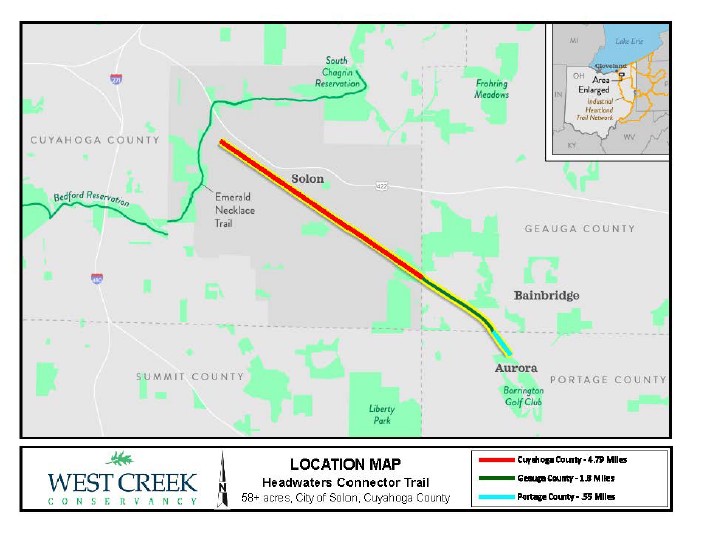
The Headwaters Connector Greenway is envisioned as a continuous trail linking segments in Cuyahoga, Geauga and Portage counties, with Solon’s section tying into other regional routes such as the Solon-to–Chagrin Falls Trail.
Assignment and Transfer Agreements Approved
At the Dec. 1 meeting, council approved Ordinance 2025-228, authorizing Mayor Edward H. Kraus to sign:
- An Assignment Agreement of Agreement of Purchase and Sale involving:
- Norfolk Southern Railway Company
- Open Space Institute Land Trust, Inc. (OSILT)
- West Creek Conservancy
- The City of Solon
- A Transfer Agreement between West Creek Conservancy and the City of Solon
The documents formalize how Solon, West Creek Conservancy and other partners will share in the acquisition and eventual management of the former Norfolk Southern railway corridor.
Under the structure spelled out in the ordinance:
- OSILT originally entered into an Agreement of Purchase and Sale with Norfolk Southern in December 2024, later amended.
- OSILT is now assigning its purchase rights to West Creek Conservancy and the City of Solon, with Norfolk Southern’s consent.
- A separate Transfer Agreement between West Creek and Solon defines how the two co-assignees will divide responsibilities and interests in the corridor after the deal closes.
The project area includes an estimated 7.14 miles of abandoned railroad corridor between mileposts RH 15 and RH 22 across three counties. Solon will become the owner of the portion that runs through:
- The City of Solon in Cuyahoga County
- Bainbridge Township in Geauga County
Those segments are collectively referred to as the “Solon Property” in the legislation.
Council members described the vote as a major milestone in a process that started in 2019, crediting Associate Director of Law Sarah H. Kostura, Law Director Thomas G. Lobe, city staff and resident Maria Farley for pushing the project forward.
Railbanked Corridor Under Rails-to-Trails Law
The ordinance notes that the corridor will be preserved and used under federal rails-to-trails “railbanking” law, which allows unused rail lines to be converted into trails while maintaining the option of rail service in the future.
Solon’s acquisition and future use of the corridor must comply with:
- Section 8(d) of the National Trails System Act, 16 U.S.C. 1247(d)
- 49 C.F.R. 1152.29, which governs interim trail use agreements
Together, those rules allow the corridor to function as a public recreational trail while technically remaining a railbanked right-of-way.
Norfolk Southern, Solon and West Creek Conservancy have negotiated a Revised Trail Use Agreement that establishes each party’s obligations under federal railbanking requirements, including long-term maintenance and liability provisions.
Building on Earlier Council Actions
The latest ordinance builds on a series of moves Solon City Council has taken to keep the project on schedule:
- Council previously authorized the mayor to sign a Statement of Willingness to Assume Financial Responsibility for the corridor – a federal requirement for rails-to-trails conversions.
- The city approved a Memorandum of Understanding with Bainbridge Township spelling out how the two communities will coordinate on the Headwaters Connector Greenway.
- In November, council approved lot consolidations for multiple parcels related to the corridor, another technical step needed before closing on the property.
- Council also authorized the city to help finance the purchase and improvements through bond anticipation notes, short-term securities issued in advance of longer-term financing.
Taken together, the ordinances and agreements give Solon a clearer path to closing on its share of the corridor and beginning detailed trail planning, in coordination with partners in Bainbridge Township and the City of Aurora in Portage County.
Residents who want more background on these earlier steps and the project’s regional scope can revisit NE Ohio News’ previous coverage in Solon Council Moves Forward on Headwaters Connector Greenway Trail.
What the Trail Could Mean for Solon
While design and construction timelines have not yet been finalized, city officials have consistently framed the Headwaters Connector Greenway as part of a broader vision for a more walkable, bikeable and connected community.
The corridor described in the purchase documents passes near:
- Residential neighborhoods
- Commercial corridors
- Existing and planned recreation routes
Once built, the trail would:
- Provide Solon residents with a new off-road option for walking, running and biking
- Improve access between neighborhoods and nearby communities like Bainbridge Township and Aurora
- Lay groundwork for future links to other regional trail systems, including the Solon-to–Chagrin Falls Trail and other projects championed by West Creek Conservancy and its partners
Solon’s ordinance declares the measure an emergency, citing the need to approve and execute the agreements quickly “to effectuate the closing of the purchase of the Property.”
That urgency reflects the tight timelines and coordinated work required when multiple communities, a rail company and several conservation groups are all involved in the same corridor.