



RELATED: Hudson Police Blotter: Theft, Fraud, Suspicious Calls
RELATED: Starting a Business in Hudson Ohio: Local Resources
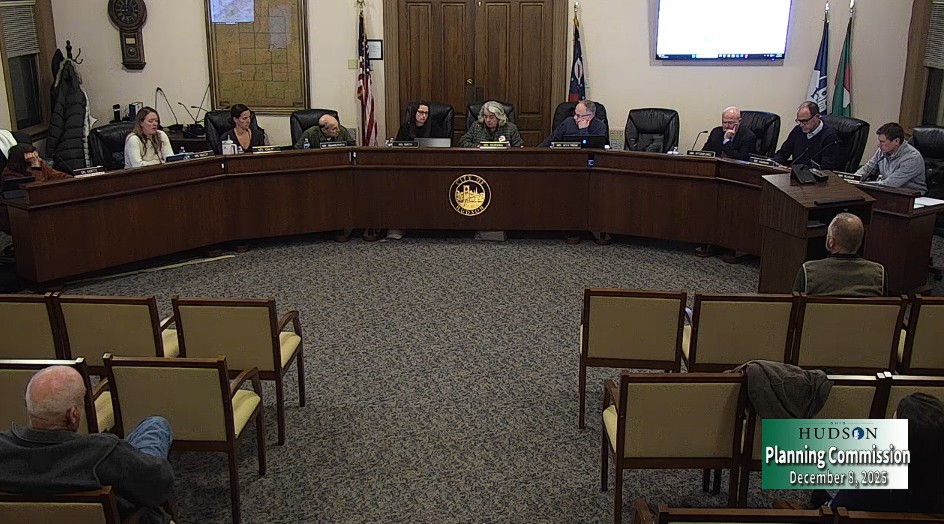
HUDSON, Ohio – The future of the former Jo-Ann Fabrics property again dominated discussion as the Hudson Planning Commission dug into how much housing should be allowed in the proposed District 11 and across the city, and whether Hudson’s rules truly reflect what residents want.
The Jo-Ann Fabrics Hudson redevelopment question is no longer just about one 100‑acre site off Seasons Road; it’s becoming the test case for how Hudson balances economic development, residential growth, infrastructure strain and the North Star of its comprehensive plan.













Commissioners also took a hard look at a city-led plan for a small parking lot at Robinson Field Park, debated how tightly written findings of fact should be before controversial decisions are made, and reviewed broader density and growth-management policies that could shape projects across Hudson.
Jo-Ann Fabrics Hudson Redevelopment: District 11 Density Under the Microscope
At the heart of the District 11 debate is a simple but unsettling math problem.
Chair Sarah Norman walked through an example using the former Jo-Ann Fabrics Hudson property, often described as roughly 100 acres. Under the current draft for the new District 11 zoning, residential density could theoretically reach:
- 20 townhome units per acre
- 30 multifamily units per acre
Norman laid out a scenario: if 50 of those 100 acres were developed, and housing was concentrated on just half of that (25 acres), the outcomes could be:
- 500 townhomes on 25 acres (20 units/acre), or
- 750 multifamily units on 25 acres (30 units/acre)
She called the result “an outrageous number” and warned that, without tighter controls, District 11 could become “a developer’s field day on flooding our town with incredibly intense residential development.”
Staff stressed that any District 11 project would have to come in as a planned development and that the purpose statement clearly says the area is “intended to encourage a predominance of commercial and light industrial uses,” with housing secondary. But commissioners pushed back that purpose statements alone are not enough when the code’s numbers allow significantly higher density.
One layer deeper, Norman questioned whether the building standards are even realistic. With a maximum building height of 50 feet and a maximum of 30 dwelling units per multifamily building, she asked whether 30 units in a 50‑foot structure are architecturally feasible once setbacks, parking, and open space are accounted for. Staff said they would need more research.
Jo-Ann Fabrics Hudson Redevelopment as a Test of Transition Housing
Commissioner Angela Smith, who represents Ward 3, focused on transition and neighborhood protection, especially for residents along Dare Road, which directly abuts the Jo-Ann Fabrics site.
Smith said she liked staff’s idea of using townhomes as a buffer on the northern edge of the District 11 area—particularly near Dare Road—so residents would not face an abrupt shift from single-family homes to industrial facades.
“I really did like your idea of doing a transition and putting townhomes on the other side of Dare Road, so it didn’t just transition to industrial,” Smith said. “If we could write it so it’s zoned that way to transition easier from the neighborhood, I think it would be really good for the community.”
City planner Nick Sugar noted that any townhome component in District 11 would have to come in as a planned development, giving the city leverage to shape where housing is placed and how it relates to existing neighborhoods.
Staff took notes to:
- Explore visuals for what buildout could look like on the Jo-Ann Fabrics land and other District 11 properties.
- Consider revising the purpose statement and language to make it even clearer that housing must be secondary and smaller in scale.
- Suggest that residential uses in District 11 act as a transition along the northern edge rather than the dominant use across the site.
Commissioners also raised the issue of impervious surface, which in District 11 could reach 75%. Norman asked whether the stormwater system in that area could realistically handle the maximum coverage. Sugar responded that Hudson’s current stormwater requirements compel greater abatement than the new hard surface being added, and he did not view 75% as a stormwater concern under current standards.
How Many Apartments Does Hudson Really Want?
Smith asked staff to calculate a citywide picture: if Hudson allows up to 30 apartments per acre in some districts, how many total apartment units could be built under existing rules—and how that compares to what residents actually want.
She pointed out that the comprehensive plan shows very low resident appetite for additional apartments, and said any density talk must be grounded in those numbers.
“The one thing I noticed on the comprehensive plan and your study, the desire for apartment units is extremely low from the residents,” Smith said. “So I see 30 units per acre, and I just wonder, well, how many would that be in total if we ran with that?”
Sugar acknowledged that the 30 units per acre figure comes from existing standards in District 5 and was used as a baseline, but not necessarily as a final answer for District 11 or future mixed-use areas.
Commissioner Fred Inamorato argued that Hudson already has a visual template for what residents are comfortable with, pointing to the Clinton Street townhomes, which sit at roughly 12 units per acre.
“To me, that’s a good density for a visual,” Inamorato said. “Right now I think 20 townhouses per acre is too much… What we currently have is what I think the community wants.”
He also questioned apartment allowances in the code, given the comprehensive plan signals little demand.
Using Jo-Ann Fabrics to Rethink Density Citywide
Because the Jo-Ann Fabrics Hudson redevelopment is tied to the broader LDC 2026 rewrite, commissioners agreed not to rush density decisions while City Council is still weighing separate legislation on large-scale senior living and institutional residential uses.
That pending legislation would, among other things, limit where big senior facilities could be built based on distance from emergency services, in keeping with the comprehensive plan. Commissioners noted that whatever Council decides will materially shape the density conversation.
The Planning Commission voted to postpone final density recommendations and asked staff to work with consultant OHM Advisors on a deeper analysis, including:
- How Hudson’s current densities for different housing types (single-family, townhomes, multifamily, senior living, institutional residential) compare with peer suburbs.
- Whether the city’s existing density schedule truly reflects resident preferences and the comprehensive plan.
- Recommendations tailored to Hudson for density caps in District 11 and other key focus areas, including the Jo-Ann Fabrics site and Clinton Street.
Norman said she wants OHM to be able to “defend the schedule,” meaning explain which numbers are justified, which aren’t, and what should change.
Findings of Fact, Laurel Lake and Protecting the City in Appeals
Although not directly about Jo-Ann Fabrics, a lengthy discussion about findings of fact and the Laurel Lake appeal colored the entire meeting—and will likely influence how the Commission handles contentious projects going forward.
Norman said she was troubled that in some high-impact cases, planning decisions have been supported by relatively short written findings, while the Board of Zoning and Building Appeals (BZBA) has issued multi-page, single-spaced findings in its appeal decisions.
She noted that Hudson’s land development code requires all planning commission decisions to be based on written findings of fact tied to specific standards in the code—not just a motion and a vote.
Norman floated a different approach: instead of voting and signing off on staff-drafted findings after the fact, the Commission could:
- Announce a date at which it will render a decision.
- Direct staff and the law department to prepare detailed draft findings.
- Review and adopt those findings at a subsequent meeting, even if the applicant already has practical direction.
Commissioners and staff discussed how this might work in practice, including concerns about applicant timelines and business-friendliness. Still, several members said they favored stronger, more detailed findings—particularly for large or controversial projects like senior communities, major rezonings, and the eventual Jo-Ann Fabrics Hudson redevelopment.
Robinson Field Park Parking Lot: Small Project, Big Questions
The Commission also held a public hearing on a city-led proposal for a three-space parking lot and turnaround at Robinson Field Park, at the southeast corner of Ravenna Street and Stow Road.
Residents across from the site said they support eventually seeing the wetland-heavy property become a real park with trails and boardwalks, but questioned why the city would build a parking lot now when:
- The park has no clear master plan.
- There is no current funding in the five-year budget for trails or boardwalks.
- The site could easily become a loitering or dumping spot if it remains just a tiny, screened lot with a couple of picnic tables.
Commissioner Jessie Obert said it felt like “putting the cart before the horse,” spending tens of thousands of dollars on a parking lot for an undeveloped park that may not see major investment for years.
Norman and other commissioners also raised legal and code-based concerns:
- The entire parcel is mapped in Hudson’s Important Ecological Integrity (IEI) appendix.
- The Land Development Code requires the city to preserve existing IEI levels, not convert colored IEI areas to non-IEI (white) by development.
- The plan lacked a required handicapped parking space, despite code provisions that at least one is required for lots of 1–25 spaces.
- Stormwater design relied on a swale, even though the code generally discourages swales and ditches as primary stormwater controls for new development.
The city’s engineer and public works officials responded that:
- They selected the location to avoid direct wetland impacts, meet sight-distance standards and fit within existing constraints.
- Staff could add the accessible parking space, show all utilities (including an Akron waterline) and tweak driveway geometry and signage.
- They would review the IEI and stormwater swale concerns with staff and the law director.
Commissioners ultimately continued the case to January, directing staff to return with revisions that:
- Add at least one handicapped parking space.
- Show all existing utilities on the plans.
- Minimize or avoid IEI impacts, consistent with code language.
- Adjust the driveway design and consider additional security and anti-loitering measures (such as signage and careful thinking about evergreen screening).
Comprehensive Plan References and Growth Management
Beyond specific projects, the Commission also:
Strengthened Links to the Comprehensive Plan
Working with OHM Advisors, staff proposed text amendments to the Land Development Code to more clearly state:
- That Hudson’s comprehensive plan is the guiding “North Star” for land-use decisions.
- That zoning and site-plan decisions should implement and be measured against the plan’s goals, focus areas and policies.
Commissioners supported the changes but asked staff to avoid citing specific chapter numbers (like “Chapter 3” or “Chapter 4”) that could change in future plan updates. Instead, they want more general language that still makes the plan directly relevant and enforceable.
They voted to recommend City Council initiate a text amendment incorporating OHM’s recommendations, with those minor edits.
Reviewed the Growth Management Program
Hudson’s longstanding Growth Management Allocation program, first adopted in 1996, is currently paused. Council must annually review whether to restart it if population growth exceeds 1.5% per year.
Planning Manager Tod Hannon reported that:
- In recent years, Hudson has added far fewer new dwelling units than the 1.5% trigger would anticipate—about a third of the threshold needed to consider turning the program back on, even with the recent Preserve at Hudson project.
- Under current code, Hudson would need roughly 120 dwelling units per year to hit the 1.5% mark.
Norman cautioned that population is now a poor proxy for real development impact. She suggested Hudson eventually consider a more modern metric that factors in:
- Remaining buildable land
- Infrastructure load (roads, utilities, broadband)
- Demolition/rebuild dynamics
- High-intensity commercial and industrial uses
Even so, the Commission voted to support the City Manager’s recommendation not to reactivate the growth management allocation system this year, while making clear they want the entire concept of “growth management” revisited as part of the broader LDC 2026 effort.
What’s Next for Jo-Ann Fabrics Hudson Redevelopment and District 11
The District 11 text and map amendment—including the framework that would govern any Jo-Ann Fabrics Hudson redevelopment—was continued to the January meeting.
Before it comes back:
- Staff will run density and yield scenarios, paying particular attention to the Jo-Ann campus and other large parcels.
- Visuals and buildout sketches will be prepared to show what 20 townhomes per acre or 30 multifamily units per acre would look like on the ground.
- OHM will begin digging into density comparisons and how Hudson’s rules stack up against similar communities.
- City Council will consider pending senior living and institutional residential code changes that could reshape how large housing projects move through the city.
As for the rest of the code tweaks and the potential repeal of Hudson’s temporary planning moratorium, Council is expected to continue those discussions in December and early January, with Planning Commission members planning to attend and weigh in.