

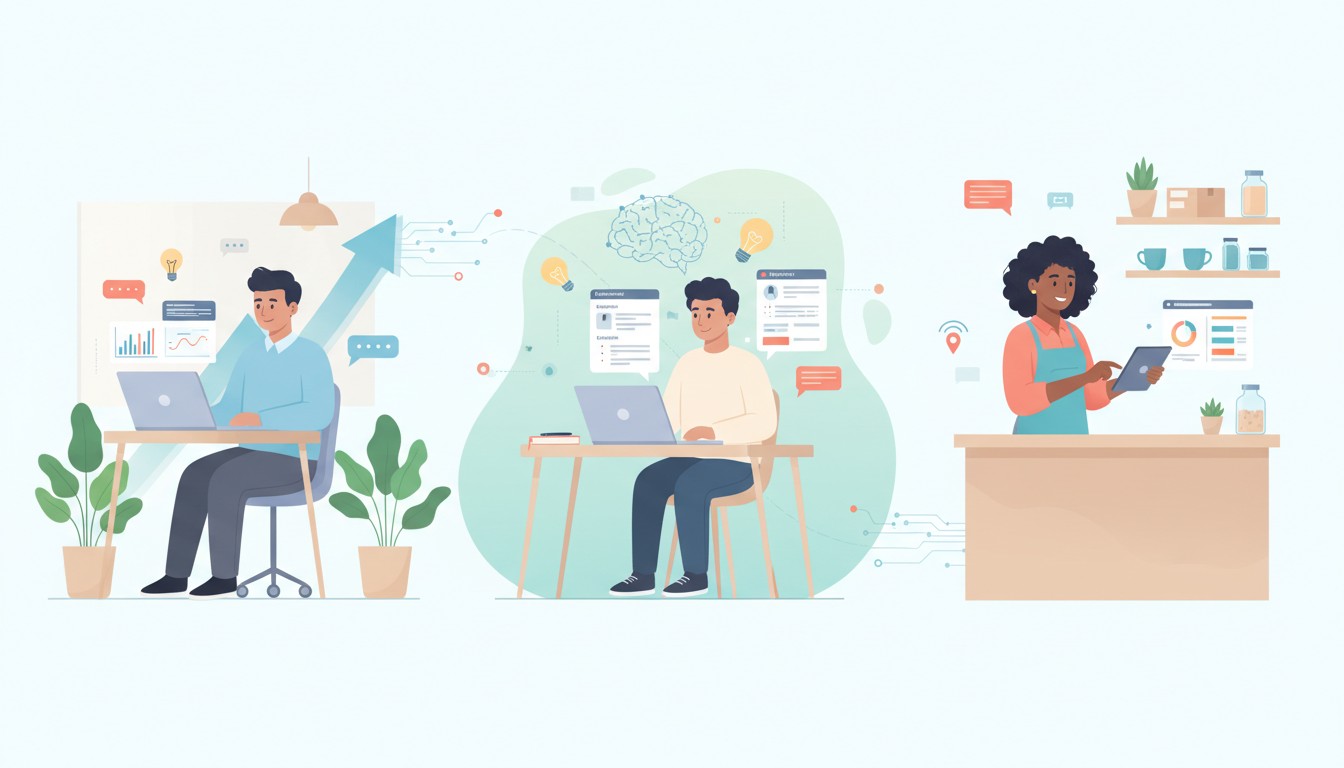

The conversation around artificial intelligence has shifted from “if” it will change our lives to “how fast” it is happening. For many in Northeast Ohio, the pressure to keep up can feel overwhelming. However, the secret to staying relevant isn’t becoming a computer scientist; it is developing AI literacy. Whether you are looking for your next role, trying to secure your current position, or scaling a company, knowing how to learn AI is the most valuable skill you can acquire this year.
The Foundation: What Everyone Needs to Know
Before diving into specific career paths, every person should research the basics of an ai learning guide. This creates a foundation that prevents you from being misled by hype or scams.
- Generative AI vs. Automation
Research the difference between AI that creates new content (like text or images) and AI that follows set rules to perform repetitive tasks. - The Art of the Prompt
Learn the “Role–Context–Task” framework. Instead of asking a simple question, tell the AI: “You are an expert [Role], here is my [Context], please perform this [Task].” - AI Ethics and Limitations
Understand “hallucinations”—where AI confidently states false information—and why human fact-checking is non-negotiable.
For the Job Seeker: Turning AI Into an Advantage
If you are currently between jobs, AI is your most powerful research and preparation tool. It can act as a 24/7 career coach.










- Resume Optimization
Research how to use AI to compare your resume against a job description to find “keyword gaps” that might be getting you filtered out by automated systems. - Skill Translation
Use AI to research how your past experience in one industry (like retail or manufacturing) translates into high-growth AI-adjacent roles. - Interview Simulation
Practice mock interviews by asking an AI to “interview me for a project manager position and give me feedback on my answers.”
For the Employee: Becoming “AI-Augmented”
For those working for someone else, the goal is to use AI to increase your output while decreasing your stress. You want to be the person who knows how to use the tools, not the person replaced by them.
- Workflow Auditing
Look at your daily calendar and identify the three most repetitive tasks. Research “AI tools for [your job title]” to find specific software that can automate or speed up those tasks. - Internal AI Policies
Research your company’s stance on AI. If they don’t have one, look up “standard corporate AI usage policies” so you can help lead the conversation on safe, responsible use. - Communication Enhancement
Use AI to draft difficult emails, summarize long meeting transcripts, or create first drafts of reports and presentations.
For the Employee Who Wants a Promotion or Better Job
If you’re not just trying to keep your job but actively aiming higher, AI can be your private career accelerator.
What to Research:
-
AI Skills Listed in Higher-Level Job Descriptions
- Search job boards for the next role up from yours (for example, coordinator → manager, analyst → senior analyst).
- Use AI to analyze several postings and ask:
- “What AI-related skills or tools appear most often in these job descriptions?”
- Make a short list: tools (Excel, Power BI, ChatGPT), skills (data analysis, automation, reporting, documentation).
-
AI for Leadership-Level Tasks
Research:- “Using AI for strategic planning”
- “AI for project management”
- “AI for business analysis and reporting”
Learn how AI can help you: - Turn raw data into clear charts and talking points
- Draft project plans, risk logs, and status updates
- Prepare executive-style summaries for your manager
-
Creating a Personal “AI Portfolio” at Work
Look up:- “AI productivity case studies”
- “AI at work success stories”
Then start building your own: - Document 3–5 examples where you used AI to:
- Save time or money
- Improve quality or accuracy
- Help your team complete a project faster
- Track the “before” and “after” so you can show real impact.
How to Use AI in Your Promotion Strategy:
-
Ask AI to:
- Review your resume and rewrite it for an internal promotion to [target role].
- Help you draft a promotion case:
- “Help me write a one-page summary explaining why I’m ready for [new role], using these accomplishments.”
- Role-play tough conversations:
- “Act as my manager. I want to ask for a promotion. Ask realistic questions and objections so I can practice my answers.”
-
Use AI to upskill quickly:
- Take a skill gap (e.g., “I need basic data analysis skills”) and ask AI to create a 30-day learning plan with:
- Weekly topics
- Practice exercises
- Simple projects you can mention in your promotion discussion
- Take a skill gap (e.g., “I need basic data analysis skills”) and ask AI to create a 30-day learning plan with:
By combining visible AI-driven wins at work with a clear narrative of your growth, you position yourself as someone who not only does the job, but elevates how the job is done.
For the Business Owner: Scaling Without the Overhead
Small business owners can use AI to compete with much larger corporations by automating marketing, customer service, and operations.
- AI Marketing Funnels
Research how to use AI to generate a month’s worth of social media content, blog posts, and email newsletters in a single afternoon. - Customer Support Automation
Look into “AI chatbots for small business” that can answer customer FAQs on your website at all hours without you needing to be online. - Data-Driven Decisions
Research how to feed your sales spreadsheets into an AI tool to find patterns, such as slow seasons, best-selling products, or services with the highest margins.
For Students, Retirees, and Creatives
AI is a tool for lifelong learning and personal enrichment, not just a paycheck.
- Students
Research “AI for ethical studying” to learn how to use AI as a tutor that explains complex topics, breaks down readings, and generates practice questions. - Retirees
Explore AI for personal projects, such as organizing family genealogies, writing memoirs, planning trips, or learning new hobbies at your own pace. - Creatives
Research “AI as a co-creator.” Use it to brainstorm plot points for a novel, generate color palettes for a painting, test titles and back-cover copy, or refine lyrics and themes.