



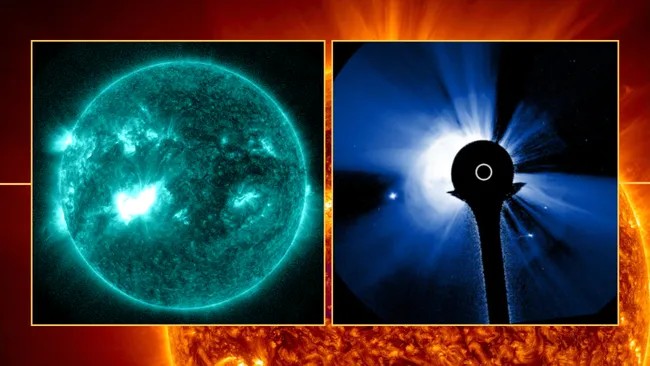

As of mid‑afternoon Monday, scientists are monitoring the aftermath of a powerful eruption on the sun that has already caused radio disruptions on Earth and could still trigger additional space‑weather effects later today or tonight.
The event involved a strong solar flare and a massive cloud of solar material now traveling through space toward Earth.
The activity is being tracked by NASA and the National Oceanic and Atmospheric Administration (NOAA), which monitor space weather events that can affect Earth. The eruption and its potential impacts were also reported by Space.com, which covers solar activity and space weather forecasting.











What Happened on the Sun
The sun released a powerful X‑class solar flare Sunday afternoon from an active sunspot region, according to the National Oceanic and Atmospheric Administration (NOAA). X‑class flares are the most intense type of solar explosion the sun can produce.
The flare caused strong radio blackouts on the sunlit side of Earth, particularly across parts of North and South America. Those disruptions occurred shortly after the flare and have since subsided.
What Is Headed Toward Earth
Along with the flare, the sun blasted a huge cloud of charged particles into space. Scientists call this a coronal mass ejection, or CME.
In simpler terms, it is a giant solar cloud that can disturb Earth’s magnetic field if it arrives head‑on. Computer models from NASA and NOAA show this solar cloud is moving toward Earth and could arrive later today or overnight.
Why the Impact Is Uncertain
Not every solar storm affects Earth in the same way. The outcome depends on how the incoming solar material interacts with Earth’s magnetic field.
If the magnetic fields align in a way that allows energy to enter Earth’s atmosphere, the result can be a geomagnetic storm. If not, the effects may be limited.
Spacecraft positioned between the sun and Earth will sample the solar cloud shortly before it arrives, giving scientists a clearer picture of its potential strength.
Possible Effects on Earth
If a geomagnetic storm develops, scientists say it could:
- Disrupt satellite operations
- Slightly degrade GPS accuracy
- Increase activity in Earth’s upper atmosphere
It could also increase the chances of seeing the aurora borealis, also known as the northern lights, in parts of the United States farther south than usual.
Can solar flares knock out cell phone service?
Generally, no. According to NASA and Space.com, most solar flares affect satellites and radio signals, not ground‑based cellular networks. Only extremely rare, historic‑level solar storms would pose a broader risk.
Why Solar Activity Is Elevated
The sun is approaching the peak of its 11‑year solar activity cycle, a period marked by more frequent solar eruptions. Solar scientists have documented increased activity throughout late 2024, 2025 and into early 2026.
During this time, powerful solar flares and solar storms become more common.
What Happens Next
Space‑weather agencies will continue to monitor conditions through the evening. Forecasts may change as new data becomes available.