



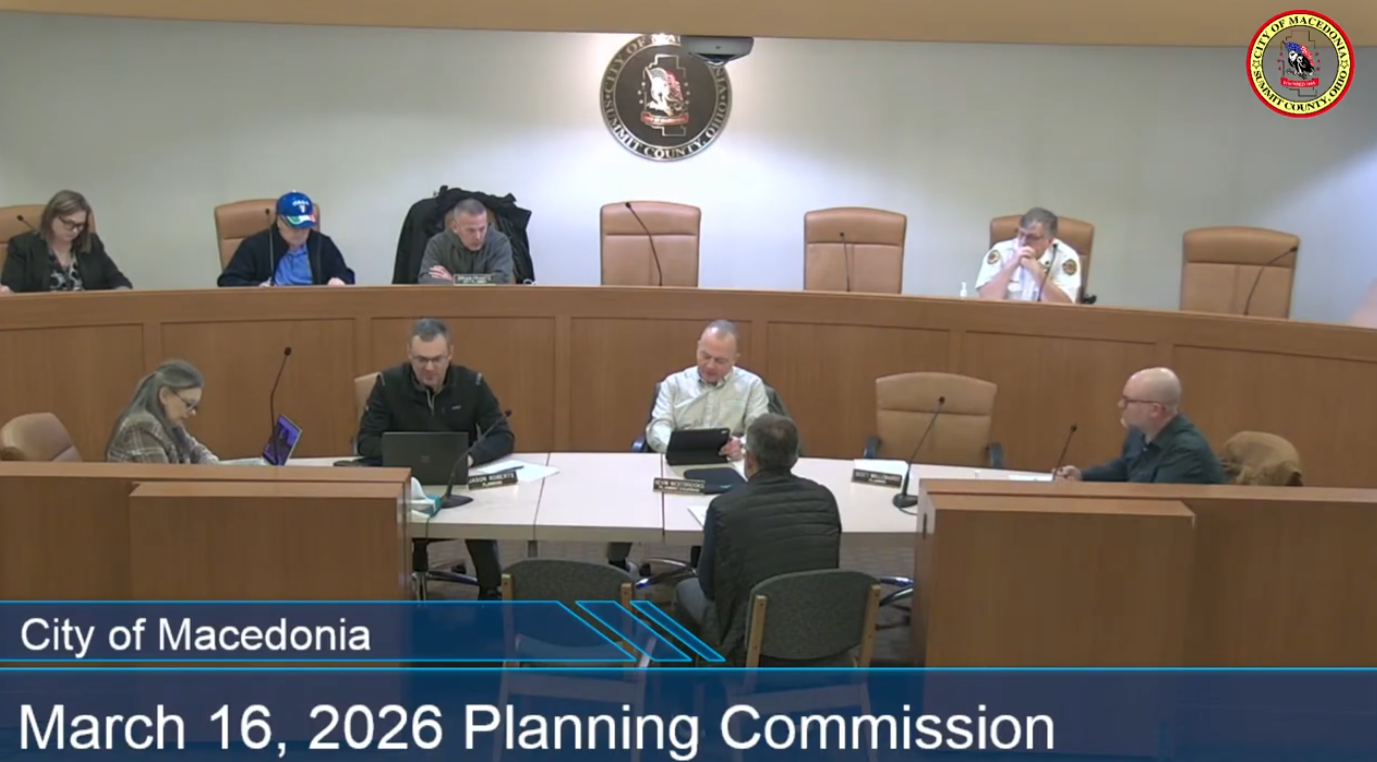

MACEDONIA, Ohio – The Planning Commission in Macedonia approved a request for new wall signage for White Glove Detailing during its March 16, 2026 meeting, granting conditional approval pending additional documentation.
The business, located at 779 Capitol Boulevard, must submit a detailed site plan and obtain written permission from the property owner before final permits can be issued.
Frontage Calculation Key to Approval
Discussion centered on whether the proposed signage complies with the city’s zoning code governing tenant frontage. Under Section 1179.03(f)(2), businesses are allowed up to two square feet of signage per linear foot of building frontage.













White Glove Detailing proposed two wall signs totaling 56.5 square feet:
-
One 4-by-8-foot sign (32 square feet)
-
One 3.5-by-7-foot sign (24.5 square feet)
While the building spans roughly 155 to 195 feet, the exact frontage occupied by the business was initially unclear due to a sublease arrangement. The applicant clarified that despite leasing out a front office, the business occupies most of the unit—estimated between 105 and 125 feet of frontage.
At that size, the allowable signage would exceed 200 square feet, placing the request well within code limits once verified.
Sign Design Fits Industrial Setting
Commission members also reviewed the proposed materials. While higher-end channel lettering is typically preferred, the applicant indicated the signs would be aluminum cabinet-style.
Given the property’s location in a General Industrial district at the end of Capitol Boulevard, commissioners agreed the design aligns with the surrounding area.
Final Steps Before Permit Issuance
The commission approved the request subject to administrative review. To move forward, the applicant must provide:
-
A marked-up site plan showing exact tenant frontage
-
A full inventory of existing building signage
-
A letter from the property owner authorizing installation
Once submitted and verified, the building department can issue the final permit.
The meeting also included the introduction of a new commission member, Michael, and highlighted the city’s transition from paper plans to digital document systems.